


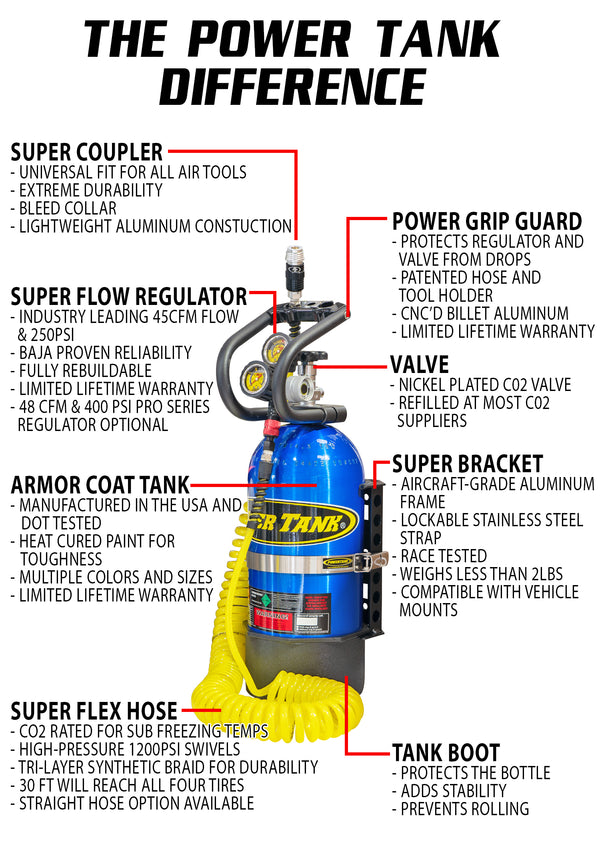

Power Tank is the only way to air up a 40" tire in under a minute and the only portable air system that can run air tools at full power!
Power Tank was first developed out of a need for fast, portable, reliable air for off-road vehicles with increasingly larger tires. The very first Power Tanks were made from CO2 bottles and off-the-shelf hardware in founder Steve's garage. 20 years of refinements and improvements later, Power Tanks are still made-to-order by hand in Lodi, CA but with much improved hardware and components like proprietary Super Flow™ Regulators, armorcoat CO2 cylinders, a collection of mounting brackets, bespoke hoses and couplers, a full line of heavy-duty tire inflators, and high-flow Monster Valve tire stems.
Power Tank also has a line of Nitrogen equipment for shock tuning, a set of off-road and marine focused propane tank brackets, ARB and air locker kits, and mini Power Tanks for quads and side-by-sides.
Not limited to off-road use, Power Tanks can be found working hard at construction sites, in towing service vehicles, and in all forms and levels of motorsport. We have contracted with the US Forest Service and the UK Military to provide tough, proven equipment that won’t fail in the field.
When you buy a Power Tank you get smart design, high performance, guaranteed reliability, and the best warranty in the industry.
How many tires will a Power Tank fill?
This chart shows how many tires a 10 lb Power Tank can air up and how long it will take per tire. Power Tanks are also available in 5 lb, 15 lb, and 20 lb sizes to suit your needs. Click here for our full tire air up chart.| If you add 10 psi | If you add 15 psi | If you add 20 psi | ||||
| What's your tire size? | sec/tire | # of tires | sec/tire | # of tires | sec/tire | # of tires |
| 33R12.50x17 | 19 sec. | 38 | 29 sec. | 29 | 38 sec. | 19 |
| 35R12.50x17 | 20 sec. | 32 | 30 sec. | 24 | 40 sec. | 16 |
| 37R12.50x17 | 25 sec. | 28 | 38 sec. | 21 | 50 sec. | 14 |
| 40R13.50x17 | 30 sec. | 22 | 45 sec. | 16 | 60 sec. | 11 |
Can I use a Power Tank to run air tools?
Power Tanks are excellent at running air tools. They operate silently, do not require electricity, and are much smaller and easier to transport than most compressors. A 10 lb Power Tank can perform the same amount of work as 400 gallons of compressed air at 150 psi. They also offer about 3 times the energy density of Nitrogen because CO2 is stored as a dense liquid under pressure. Click here for our full air tool usage chart.A Power Tank can run a 1/2" impact wrench at full power.
| Removing lug nuts torqued to 90 ft/lbs | 10 lb (PT10) |
| IR231 1/2" Impact Wrench | 360 |
This chart shows the amount of nails you can shoot from various nail gun types.
| Nail Gun Model | Nail Size | Material & Thickness | 10 lb (PT10) |
| Hitachi NR90AE | 16d | Doug. Fir 4x6 | 880 |
| Hitachi NR83A Framing Nailer |
8d | 1/2-inch Plywood + Stud | 1500 |
| Senco SFN40 Finish Pro Nailer |
15ga x 2.5 (DA25) |
Maple | 3000 |
| Senco SLP20 Brad Finish Nailer |
18ga x 1.5 | Various | 6000 |
| Bostich Coiled Roofing Nail Gun | 1.5" coiled | 1/2" OSB or CDX | 2400 |
Can I fill it at home? How do I refill my Power Tank?
Power Tanks are filled with liquid CO2 at various businesses around the country. Before purchasing your Power Tank you should find a local business that can refill CO2 on-site. Contact local Fire Extinguisher Service Shops, Welding Gas Suppliers, Beverage Carbonics, and Homebrew Supply businesses and ask if they refill personally owned CO2 beverage bottles. If they do, great! Even better if they have same-day or fill-as-you-wait services.
Some businesses will collect a group of customers' bottles and send them off-site to be filled. There is a high-chance your shiny new Power Tank will be lost or damaged in this process and should be avoided if possible. Some areas only offer tank exchanges where, like propane, you rent a cylinder and exchange it for a full one when it's empty. In this case, we offer Regulator Kits and you supply a cylinder.
We also keep a map of verified CO2 refillers and Power Tank dealers. This list is by no means complete and relies on data received by our amazing customers. It is constantly being updated.